Showing posts with label Exhibition. Show all posts

Monday, 23 April 2012

PAUL THEK YOU HAVE A GOOD LAST NAME


Paul Thek was exhibited in the Modern institue during the GI (Glasgow International) in 2012.  The exhibition entitled "If you don't like this book you don't like me." An exhibition shows the artist's private journals and pictures of his studio. As an artist in 60s, it seems that inevitably he carries a burden  with his uncombed hair and week but determined voice which you can hear in his interview video at the 2nd floor.


I decided to talk about his hair and AIDS rather than his artwork since the exhibition is mainly based on his private journals and drawings.  He was famous for his hyper realistic sculpture of himself dead, after one exhibit in Germany, the sculpture was lost or destroyed by anonymous or simply just disappeared at the end of shipping.  It has arrived where it suppose to be, but Paul never came to pick it up.  Some people said that it is because he doesn't want it to be exhibit ever again, some said that it is also because he was disappointed about the work didn't sell.

THe exhibition in Modern institue was mainly focus on Paul Thek's personal journal.  These private journals downstairs takes me to different places that Paul has ever visited, and the things that he saw and drew and everything that he decided to take notes for.  He is not a very good drawer I would say.  It is nothing precise about his drawing, there are several pages that he simply just marked lines in contrast with the ink line belongs to the notebook itself.  These private journal marked the Paul's life such as his breakfasts list or some questions has yet been made.

He seems to be a mediator constantly shifting between different values, sexs, dimensions or even more. He creates environmental art and installation, trying to build up dialogues between art and life, when art was getting more a mannerism in the US, he was trying to bring it to a state where art can meet with life, and being experienced more domestically.  He himself is a bisexual, sexual orientation is not for a single gender but depends on who you feel right with, he looks as if he pays a lot of attention to his body, you can not see much extra fat on his arms, and he is really fit, wearing a tight tank top. But he is definitely thinner than any men who does weight training would like to be.  His voice is solid and certain, but his looks give you a feeling that he might faint in any second, or scream out loud on nothing.

His famous piece is the life scale of himself, a dead body.  He creates and give birth to his death.  Experiencing the last journey by creating a possible representation of himself and then choose to lost it in a box.  A man who constantly in dialogue with things, with nature, with politics, and with rules.

I have always hated how there is a subject in academic institution called communication, or the sales man in Rocky horror picture show that shakes your hands with over performing friendly attitude.
Even if I saw and listen to Paul Thek's journals and interviews,  I would never being able to fully understand his thoughts or what he been through metaphysically.  No matter how hard I tried, I couldn't change the fact that we basically living in a total different time and space.

Should we abandon these history because they pull us back when we were being forced by time to move forward? Can anybody give me any answer?

All photos were copied from The Modern Institute.

Monday, 14 November 2011

SIESTA PINWHEEL

SOOOOOOOO. 


Curated by Stephanie Mann and Lewis den Hertog, "SIESTA PINWHEEL" happened within a painted drawer. White drawers become another white cube within the space.  Another layers being added up by the fact that viewer is not just working by, WE HAVE TO OPEN IT TO SEE THE WORK!  


Doraemon (Yes, the magic cat) decided to put a time machine in the drawer, the space has another function to fix what happened in the past, a mean to get away from reality.  Or a place where nostalgia being kept, a collective memory concern with time and space.  
Memory is a contingent stream, co-exist with our very present.  By the very action of looking into the drawer, to pull it out, interaction between give - take altered within this CO2 space.  


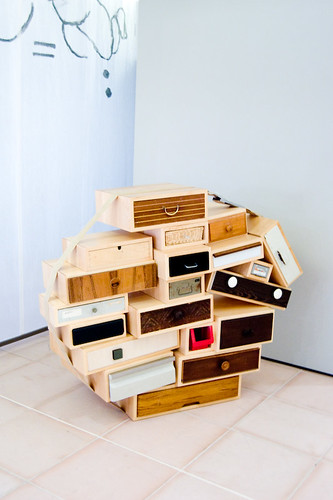
You can't lay down your memory by Tejo Remy© him
Dutch minimalist designer Tejo Remy put up a piles of used old drawers in NY, new york city where the cop sucks, in the name of Dada " You Can't lay down your memory" by acclaiming "a new value system based on economy, simplicity, and responsibility... celebrated ingenuity and poverty of means and elevated them to an aesthetic philosophy; idealism and moralism were the politically correct attitudes of the day (Text by MOMA) "


So, how about Siesta Pinwheel?


In order to see what is inside the drawers, we need to pay extra work to it, viewers feeling the need of being polite, the togetherness and politeness. You can't just walk away whenever you feel like to see next work. 
The relationship between audiences and objects become reciprocal. There are extra moments of an viewing experience, Curiosity being raised, the vibration between subjects and objects was reinforced. white paint defamiliar our sense towards the space, the pure, neutral feeling somehow altered by the fact that the object we all engaging with has the unspeakable communal memory.  Nostalgia became a collective action.  


This exhibition is portable, a moving exhibition, a travellers tale. when it s presented in the different spaces will certainly generates different meaning, regards to the time and space, enact with different public. Due to the time and space, the engaging public become varies so does the interaction alters which generate an ongoing conversation.  It reminds me of the Skulptur Projekt Münster, which happened within the whole city and the work of art requires actions which being motivated by curiosity, travel, a notion of destination, and discovery.  


     Somehow the notion of open call could be fearful, the communication become another curatorial concern during the process.  Incidents will happen by any kind of issues, like Alice Bradshaw & Bob Milner decided to go on holiday at the end.  But somehow the process being documented, and presented within Siesta Pinwheel, which adds up the feature of achieve, documented process of the event.


Thursday, 10 November 2011

54th La Biennale di Venezia - Illumination [1]

Wow Venice Biennale as the Olympics in contemporary art universe, and I, finally being able to check out WAS IST DAS!?

Due to there are too, way too many exhibitions and pavilions in Venice, I'm going to use a kind of Twitter style way to have a brief view of some pavilion in Venice. But I do have some beloved one which will take up more space. So here we go. 

There are two parts of location where this exhibition happening - Giardini and Aresenale and another part called "In the city" which means countries not yet made it to the major countries.  Somehow I found it really funny about the nationalism within this Grand Art Exhibition.


Start from the one that I like the most,

Luxembourg pavilion - http://www.feipel-bechameil.lu/
Luxemburg Pavilion © Martine Feipel & Jean Bechameil, "Le Cercle Fermé,"
With the twisted space and sculpture, I was draw into a fantastical world by the white colour and numberless reflections by the mirror, which extend the whole space.  The usage of white unreal white colour in a reflective space create a definitely kind of torn world which Alice might want to get out of it as soon as possible.  Be careful you might feel sick there though.

White is a strange colour besides reminding me of pure/ hospital/ or exhibition space, I also thought of wedding dress and somehow in Japan, the new-wed bride always have to be covered by a layer of white powder. On fashion I felt white on white is absolutely stunning match and only people who has strong character or fascial feature will be able to outline with personality.
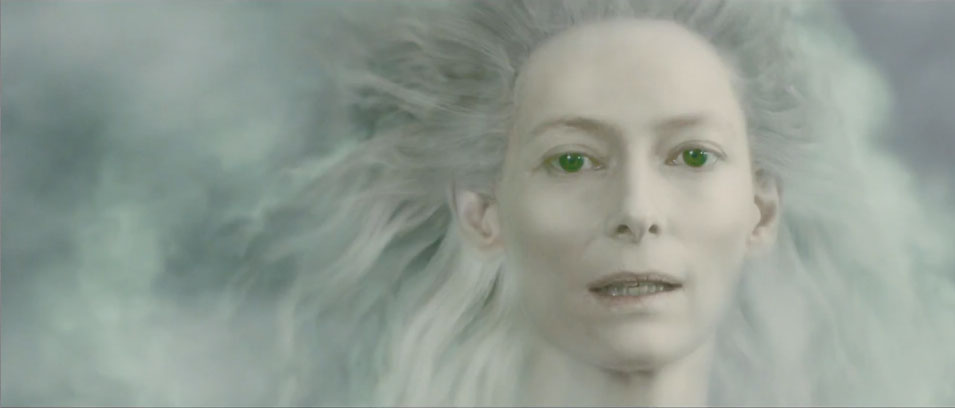
Tilda Swinton as White witch 

Wednesday, 19 October 2011

Cascade Falls ( Installation photo's and Crit)


Photo credit © Yao-Lung Cheng 
   

      To begin with the layout of the exhibition, we decided to try to make these two artists - Lindsay, Yao-Lung's work presenting a jointed relation with engaging with the representation of memories.  The space C2 is a white cube space located inside of the college, it is a room composed by the white walls as a gallery space.  The blue curtain we hang onto the window create a new landscape within the space, which I suggest to input our ideology of curtain as the stage curtain - cover what is behind the scene, or a curtain within the domestic space such as home/ private space/ restaurant/ cars as kind of implication of private/ public, be seen/ and hided from.

      As a curator of this exhibition, I would like to second several ideas and knowledge of the definition of curation, thus to discuss the role as a curator, and then I would like to talk about the artists work within the   project.  "The curator is basically in this case acting as a kind of interface between artist, institution, and audience in "the development of critical meaning in partnership and discussion with artists and publics" as Barnaby Drabble states. which curator act as a mediator, administrator and manager locate themselves within Art World, which Alloway sited as "a shifting multiple goal coalition"and it can also be regarded as an organization "a negotiating environment." Some believe that a good curator should be invisible (Burnett 2005) but the under the circumstance, contemporary curating mostly concentrates on theories of curating and can be argued to do more for the reputation of individual curators or theorists than for the sharing of curatorial skills. (Graham&Cook 2010) The history of exhibitions is one of our most culturally 'repressed.' As Mary Anne Staniszewski stressed, the contextualisation of space and its rhetoric have been overshadowed by contexualising in terms of epochs and the artists' oeuvre, despite the fact that exhibition installations have had such a crucial significance for how meaning is created in Art." (2005, 91)
     
       The exhibition layout was inspired first by both artists' work and their idea, I wanted to build up a installation layout from their meaning and things that inspired them, which I second from Graham & Cook "We believe that a good understanding of the artwork - its behaviours, processes, and cultural context - is vital starting point for all curating. (2010, 11) Lindsay's work engaging with the recreation of the non-human/ inaccessible habitat for human which were being recreated, reproduced by human being inorder to fulfill it's curiosity or to achieve something that is impossible being experience immediately or has intangible factor within it, such as past memory.

     Yao-Lung's work has two key elements within it, he arranging collected objects within the frame, and this time he presents two type of frame.  He uses ice cube and physical frames as the boundaries of his objects, or his story.  The ice cube has a dramatic effect on this space also enact within the people who were inside of the space as well. Every melting moment were participated by audiences who physically engaging with the exhibition, and people can sense its dramatically effect visually through the melting water and psychologically by the pre-exist knowledge of the science of ice.  People founds his work within the ice is giving this idea of "not wanting the edge to be defined." "can't help thinking what's going to happen when it melt --- unpredictable anticipation" with the attention of not wanting the edge to be too defined, Yao-lung's collection evoked people's imagination by using objects with shared memory (a feature of consumerism), which we can see as Ilya Kavakov who was being described simultaneously a poet of facts and a spinner of tales, in his catalogue "The Man who never threw anything away", illustrate this action as "Conceived in ideological grandeur and built on the cheap, Communism's monument were ready-made ruins, encircled, as monuments always are, by the humbler architecture of ordinary life." Not necessarily related to communism but the notion of according the objects (Time shell)  one can travel meta-physically through their past by visually absorb these little collections with differed stories.

      Lindsay's work combines two framed pictures from an aquarium in Chicago, and men-made fountain.  The fountain has a geometric shape which I located it in the middle of the room, because when the water coming out of the water nozzle contains performativity can create a kind of stage central thus make viewers to focus and being aware of.  However, the water sprung out of the fountain edge became problematic and being considered as a failure. and one of the pictures were deliberately heighten above the eye level also frustrating viewer's visibility and so did the way we displayed Yao-lung's work evoked such question.  With the cheap material and artificial colour, Disneyland, beach coma... and something that is produced deliberately to entertain people and thus they pretend to be happy .  Other two pieces on the wall can help viewers to get involved with an experience.

     The water from my point of view is a very key issue within this exhibition, I imagine the melting water, and water which sprung from the nozzle together with the dripping curtain create a coordinating format. followed by the shape of the fountain, a geometric way of displaying can be rather fit with the space and theme.  The sound of water become a distraction of the exhibition which when I was holding as a mean to engage the viewer's intention become somehow a failure or a misread attempt also state the  power of viewer and thus I thought this is a postmodern way of seeing the critics/ viewers by rotating their opinions within the room thus become a break from what happened in 60s as Alloway describe " The interpretation were being dominated pretty much bounded by the intentions of the artist, which there is a corresponding neglect of comparative and historical information (p7)" and point a direction to Duchamp were trying to propose that the function of audience is to determine the meaning of the work when it is out of the artist's hands by variable acts of "deciphering and interpreting."

     At the last, Cascade Falls ended last friday, with thanks to everyone who made it to the exhibition and the crit.  We received varies of comments and I found them highly relevant to the issue that we were trying to engage with, and from this project we founded another starting point, the power of the viewer, blurred boundary between the tangible and intangible lines, shared memory (common timespace)and thus to the interpretation from the viewer, the failure, the melancholic feeling as an aesthetic approach... to take us to different direction.